
My Osteoporosis Journey: What 12 Years of Testing Has Taught Me

Twelve years ago, at the age of 50, I was diagnosed with osteoporosis.
I still remember receiving my bone density scan results and seeing a T-score of around -3 in my spine. To put that into context, osteoporosis is diagnosed when a T-score falls below -2.5, so my result indicated significantly reduced bone density and a higher risk of fracture.
At the time, it felt overwhelming.
Like many people, I immediately started imagining brittle bones and worrying about what the future might hold. However when I left the appointment, I made a decision. I was going to learn as much as I could about osteoporosis and bone health before deciding what to do next.
What Is Osteoporosis?
Osteoporosis is a condition where bones become less dense, weaker and more fragile, increasing the risk of fractures. It develops when the body breaks down old bone faster than it can build new bone.
Although we often think of bones as static structures, they are actually living tissue that is constantly being renewed. Throughout life, old bone is removed and new bone is formed.
As we age, particularly after menopause when oestrogen levels decline, this balance can shift, causing bone density to decrease.
Osteoporosis is often called a silent condition because there are usually no symptoms until a fracture occurs.

Understanding the Different Stages of Bone Health
Bone density is measured using a DEXA scan, which produces a T-score comparing your bone density to that of a healthy young adult.
The results are generally categorised as:
🟢 Normal Bone Density
T-score of -1.0 or above
Healthy bone strength and lower fracture risk
🟡 Osteopenia
T-score between -1.0 and -2.5
Lower than normal bone density, but not yet osteoporosis
An early warning sign that bone health needs attention
🔴 Osteoporosis
T-score of -2.5 or below
Significantly reduced bone density
Increased risk of fractures, particularly in the spine, hips and wrists
What I Learned After My Diagnosis
One of the first things I discovered was that a single bone density scan only tells part of the story.
Due to that initial scan being my first, I had nothing to compare it to. I did not know whether my bone density had recently declined or whether it had remained relatively stable for many years.
I also learned that osteoporosis develops when bone is breaking down faster than the body can rebuild it. The body is constantly removing old bone and replacing it with new bone. Problems occur when that rebuilding process cannot keep pace with the breakdown.
Another important lesson was that bone density is not necessarily the same as bone strength.
Think of a thin marble tabletop compared with a thick piece of plywood. The marble may be thinner, but it is often much stronger. In the same way, a bone density score does not tell us everything about the quality and strength of the bone itself.
At the time of my diagnosis, I had experienced numerous falls throughout my life but had never broken a bone, sprained anything or suffered a significant injury. That made me question whether there might be more to the picture than my scan result alone.

Looking Beyond Bone Density
As part of my research, I learned about blood tests that measure bone turnover, essentially how quickly bone is being broken down and rebuilt.
I decided to have this testing done.
The results suggested that my bones were breaking down and rebuilding at a rate more typical of a healthy 35 year old. While that did not change my diagnosis, it gave me reassurance that my body was still actively remodelling bone and that there were other factors worth considering.
Around the same time, I also discovered that my vitamin D levels were very low.
This led me to learn much more about the nutritional foundations of healthy bones. While calcium often gets most of the attention, it is only one piece of the puzzle. Nutrients such as vitamin D3, vitamin K2, magnesium, boron, zinc and other trace minerals all play important roles in maintaining healthy bones.
Over the following 12 years, I focused on supporting my bone health through nutrition, targeted supplementation, maintaining healthy vitamin D levels and regular weight bearing exercise.
Why I Chose Not to Take Bisphosphonates

Many people diagnosed with osteoporosis are offered medications called bisphosphonates.
These drugs work by slowing down the process of bone breakdown. Bone is constantly being remodelled. Old bone is broken down while new bone is built. Bisphosphonates reduce the breakdown side of this process, which can help increase bone density but does not increase bone strength.
For me personally, I wanted to understand more about why I had developed osteoporosis in the first place and whether there were other factors contributing to it. Rather than focusing solely on bone density, I wanted to take a broader view of my bone health and look at the potential role of nutrition, hormones and lifestyle factors.
Why I Recently Revisited My Bone Health
More recently, things changed.
Over the last few years I have broken two wrists, a rib and a foot. While these injuries all had specific causes, they prompted me to take another look at my bone health and understand what was happening now.
This time, I chose a more advanced assessment that looked not only at bone density but also at bone quality and strength.
The results were encouraging.
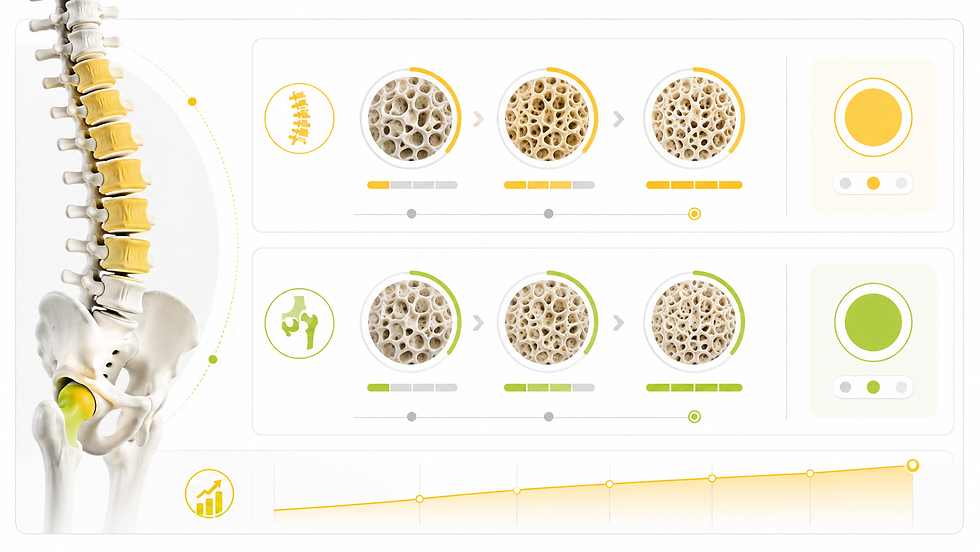
At 62 years old, my spinal T-score has improved from around -3 to -2.5. While this still technically falls within the osteoporosis category, it is now right on the borderline.
My spine bone strength was categorised as yellow on the clinic's traffic light system, while my hip bone strength was borderline green. My DEXA hip results have improved and overall my bones are certainly not fragile at this stage. There is room for improvement and this is what my aim is before my next scan in around three years time.
It's important for those concerned to realise that given the raw materials needed to build healthy bones, osteoporosis is not necessarily a fixed diagnosis for the rest of your life.
A New Perspective
I visited the Screen My Bones team at the Biogena clinic, who take a comprehensive approach to bone health.
One of the conversations that particularly resonated with me was around the role of oestrogen in maintaining healthy bones.
We know that the decline in oestrogen during and after menopause can significantly accelerate bone loss. This is often a missing piece of the osteoporosis puzzle and one that may not always receive enough attention. As a result, I am now considering whether Hormone Replacement Therapy (HRT) could be an appropriate part of my ongoing bone health strategy. For me this is very nuanced as the studies seem to indicate HRT must be started within a particular window (around 5 years) after menopause and I may have well have missed this boat but I'm certainly going to see some HRT specialists and investigate this further.
The clinic also looks at nutrition, lifestyle factors and targeted supplementation, helping to identify what may be contributing to bone loss and what support may be needed.
What I appreciated most was that the conversation was not just about bone density. It was about understanding the bigger picture and identifying the factors that might be influencing bone health both now and in the future.
What I've Learned
My journey with osteoporosis has taught me that there is rarely a single cause or a single solution.
Bone health is influenced by hormones, nutrition, digestive health, exercise, stress, genetics and lifestyle. Taking the time to understand those factors can help you make more informed decisions about your health.
If you have been diagnosed with osteopenia or osteoporosis, do not assume that your bone health is fixed or that there is nothing you can do. There are often many opportunities to support your bones and improve your long term health.
Twelve years ago, receiving that diagnosis felt frightening. Looking back now, it was the start of a much deeper understanding of how our bones work and the many factors that influence their strength.
If you would like to explore your own bone health in more detail, I have included a link below where you can book a consultation with the team at Screen My Bones.
Most importantly for me is that this bone scan is radiation-free which is something that I am always concerned about when it comes to health scans.
Thinking about your bone health?
Whether you've recently been diagnosed with osteopenia or osteoporosis, or simply want to understand your risk and take a proactive approach, I can help.
Together we can look at the bigger picture - your nutrition, digestive health, hormones, lifestyle, exercise habits and key nutrient status - and create a personalised plan to help support healthy bones for the long term.
Book a free discovery call to find out how Functional Medicine can support your bone health journey, or follow @tracytredouxhealth for regular nutrition, healthy ageing and Functional Medicine insights.


Comments